You have fire extinguishers, fire hose reels, manual call points. What symbols should you mark them with? In short: use the F-series symbols of EN ISO 7010. Below is why — and what the Directive, the Bulgarian regulation and the standards say about it.
In short
- Use the F series of EN ISO 7010 — the European edition of the international ISO 7010 (edition 3 of 2019, with 11 amendments up to March 2026).
- Why: the law allows it; the Directive has only four fire safety symbols and does not know the manual call point, the fire protection door and others; the standard is maintained regularly.
- One and the same symbol everywhere — on the wall, in the evacuation scheme and in the documentation.
- Do not use signs with the word EXIT — that is American practice, not a European standard.
What the legal minimum is
Regulation № RD-07/8 on safety signs and signals at work transposes Directive 92/58/EEC in Bulgaria. It says that:
- fire safety symbols are rectangular or square, with a white pictogram on a red background; the red covers at least 50% of the symbol (Annex № 2, item 3, letter “д”);
- fire-fighting equipment is identified in red, and its location and the route to it are marked with symbols (Annex № 4);
- pictograms may differ slightly or be more detailed than those shown, if they convey the same meaning and the differences do not make it unclear (Annex № 2, item 1, letter “в”).
Regulation № 8121з-647 refers to this regulation for the symbols in evacuation schemes.
The symbols of the Directive
Directive 92/58/EEC dates from 24 June 1992 and shows four fire safety symbols and one arrow. Each of the symbols has an equivalent in EN ISO 7010:
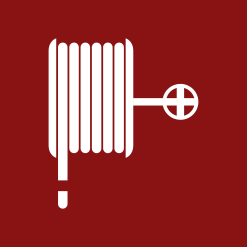 Directive 92/58/EEC
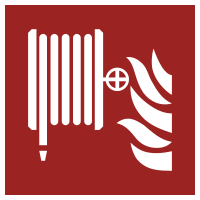 EN ISO 7010 · F002
Fire hose reel
 Directive 92/58/EEC
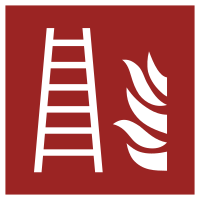 EN ISO 7010 · F003
Fire ladder
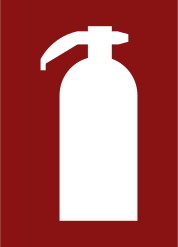 Directive 92/58/EEC
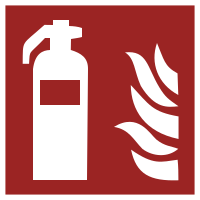 EN ISO 7010 · F001
Fire extinguisher
 Directive 92/58/EEC
 EN ISO 7010 · F006
Fire emergency telephone

“This way” arrow
Only in the Directive — not in EN ISO 7010
Directive symbols: © European Union.
The Directive has not been repealed. In 2017 the Advisory Committee on Safety and Health at Work recommended clarifying its relationship with the standard, and in December 2020 it adopted non-binding guidelines. The main points:
- the two systems coexist: the Directive is the mandatory minimum, EN ISO 7010 is a voluntary standard;
- the Directive takes precedence over the standard;
- EN ISO 7010 symbols comply with the Directive through the flexibility clause, as long as they convey the same meaning.
The symbols F001–F019
At the time of writing the EN ISO 7010 register contains F001–F019. The four that the Directive also shows are marked “In the Directive”.
F001Fire extinguisherIn the DirectiveF002Fire hose reelIn the DirectiveF003Fire ladderIn the Directive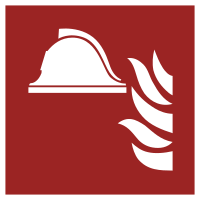 F004Collection of firefighting equipment
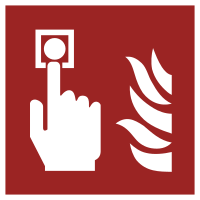 F005Fire alarm call pointF006Fire emergency telephoneIn the Directive
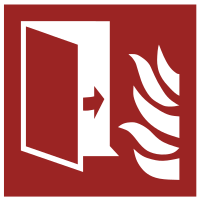 F007Fire protection door
 F008Fixed fire extinguishing battery
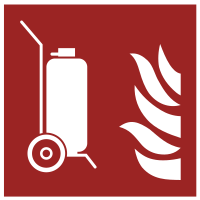 F009Wheeled fire extinguisher
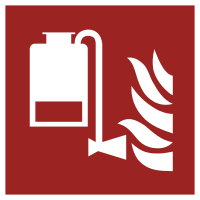 F010Portable foam applicator unit
 F011Water fog applicator
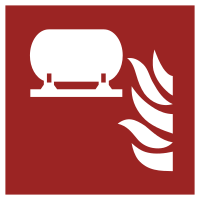 F012Fixed fire extinguishing installation
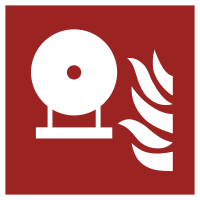 F013Fixed fire extinguishing bottle
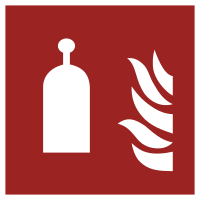 F014Remote release station
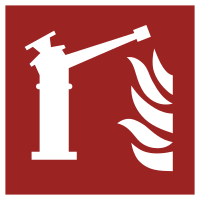 F015Fire monitor
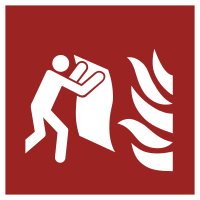 F016Fire blanket
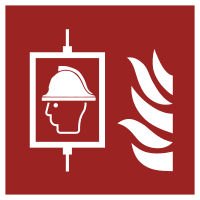 F017Firefighters' lift
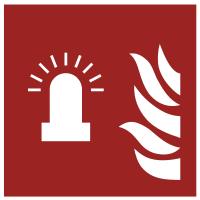 F018Fire alarm flashing light
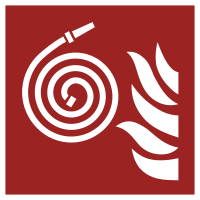 F019Unconnected fire hose
In an office, shop or hotel, F001, F002 and F005 are the most common.
F016 — the fire blanket — is rarely seen in Bulgaria, and it should be: it is the simplest means for a small fire, for example in kitchens.
The standard is supplemented regularly and the list may grow. We follow the editions — if you need a symbol you do not see here, get in touch.
The firefighters' lift — two different symbols
There are two different symbols for firefighters' lifts, and this causes confusion:
- Regulation № 8121з-647 (in force since 29.06.2025) requires a “Firefighters' lift” symbol — square, with a white pictogram on a red background; the red covers at least 50% of the symbol. The minimum sizes are 100 × 100 mm on the floor levels with access for rescue teams and 20 × 20 mm in the immediate vicinity of the lift control panels.
- EN ISO 7010 has its own symbol — F017.
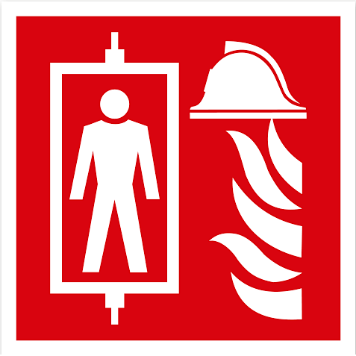
The symbol in Regulation 647 is the one from the lift standard EN 81-72, which dates from 2003 and requires its own symbol for firefighters' lifts. F017 was added to EN ISO 7010 much later. The two systems develop separately and are not synchronised.
The practical rule: on the lift itself — the symbol from Regulation 647, and in the evacuation scheme — the same symbol, so that it matches the one on the lift.
“EXIT” — European or American?
Exit signs with the word EXIT are often seen. This is not the European standard symbol:
- In the USA the word EXIT is the tradition. NFPA 101 (item 7.10.3.1) requires text exit signs, and a pictogram is allowed instead of or in addition to the text if approved by the local authority. The International Building Code (IBC) allows pictograms for internally illuminated signs only from the 2021 edition. The sign there is traditionally red or green.
- In Europe the Directive and EN ISO 7010 use a symbol that is understood without language: a white pictogram on a green background — a running man, a door and an arrow (E001/E002).
- In Bulgaria Regulation № RD-07/8 describes the evacuation exit sign (in the regulation — “emergency exit”) as rectangular or square, with a white pictogram on a green background. Wording is not required.
For a facility in Bulgaria, use the EN ISO 7010 symbol.
Colours are standardised too
The symbol is not just a drawing — its colour has meaning and is also standardised. The basis is the ISO 3864 series — it defines the colours and the principles for building the symbols, with the colours described measurably (colorimetrically and photometrically), not as “some red”:
- The red is not arbitrary. Fire safety symbols have a white pictogram on a red background, and the red covers at least 50% of the symbol.
- The colour means the same everywhere — on the wall, in the evacuation scheme and in the documentation. That is why the symbols in evacuation schemes are in these colours.
- The shade matters. A symbol printed on an ordinary printer or in an “almost the same” colour may not meet the standard — when ordering, ask the supplier for colours under the standard.
Why EN ISO 7010
- The standard is maintained. Since 2020 the international ISO 7010 has had 11 amendments. Annex II of the Directive contains four fire safety pictograms from 1992, and the regulation was last amended in 2015.
- The symbols are standardised to be understood without text — this is the stated purpose of the standard.
- They cover the real equipment — manual call point, fire protection door, blanket, firefighters' lift.
- The European Commission recognises them through the 2020 guidelines.
- A new edition is coming. When ordering symbols, ask the supplier for the code (F001…) and the current edition.
What to do on site
- Use one and the same symbol everywhere — on the wall, in the scheme's legend and in the documentation.
- For new and replaced symbols — under EN ISO 7010. Existing symbols of an older kind are not automatically a non-conformity if the meaning is the same and clear.
- Exit signs — an EN ISO 7010 symbol on a green background, not the word EXIT.
- Equipment is identified by red colour and a symbol at its place or on the route to it (RD-07/8, Annex № 4).
- The symbol does not determine where the equipment is — the places come from the design and from the operating requirements.
We design emergency lighting and prepare evacuation schemes and plans with EN ISO 7010 symbols. If you are not sure which symbols your facility needs, get in touch.