The exit sign you see in corridors is not just a running man. It is a combination of a symbol and an arrow, and the place where it is mounted is part of its meaning. Here is what each of the eight combinations means — and the most common mounting mistake.
In short
- An escape route sign is an evacuation exit symbol under EN ISO 7010 (E001 or E002) plus an arrow for direction under ISO 3864-3. The rules for combining them are in ISO 16069.
- There are eight combinations — arrow up, down, left, right and the four diagonals.
- Arrow up means “continue straight on”. Arrow down means only “go down”.
- The meaning also depends on the place of mounting.
What the sign consists of
An escape route sign has two elements:
- an evacuation exit symbol — a running man towards a door: E001 (left exit) or E002 (right exit) under EN ISO 7010; a white pictogram on a green background;
- a direction arrow — under ISO 3864-3. The arrow is not part of the symbol; it is added to it.
Directive 92/58/EEC has its own evacuation exit signs, in which the arrow is already built in. The European Commission accepts that the combination of E001/E002 and an arrow is equivalent to them, as long as the arrow shows the same direction.
The eight signs and what each means
The meaning is as seen by a person standing in front of the sign:
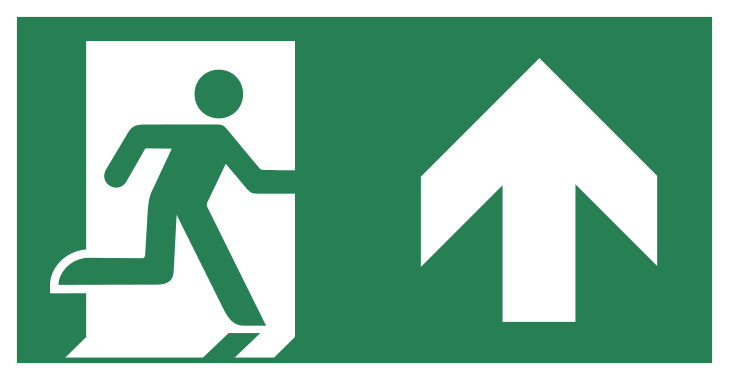
Up (straight on)
- Proceed forward from here.
- Proceed forward and through — when the sign is above a door.
- Proceed forward and up — change of level.
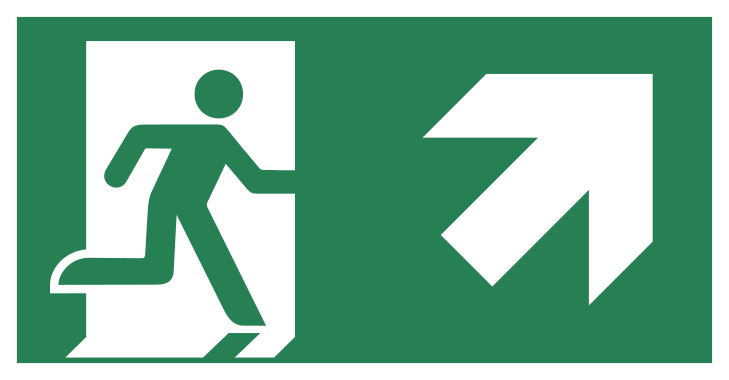
Up to the right
- Proceed up to the right — change of level.
- Proceed forward and across to the right — when in an open area.
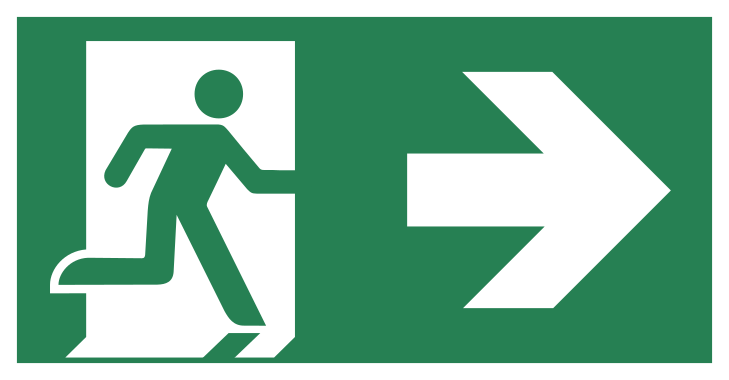
To the right
- Proceed to the right from here.
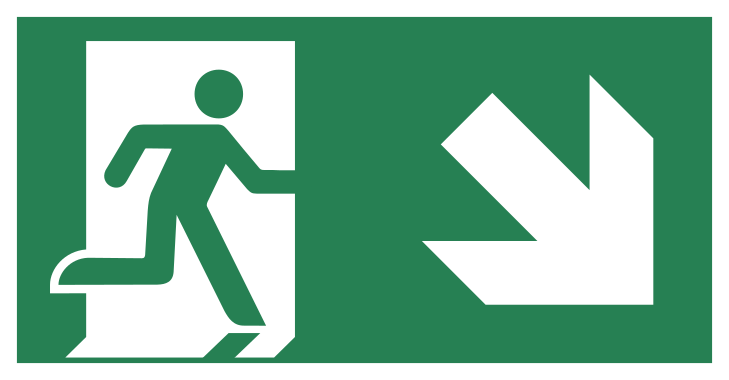
Down to the right
- Proceed down to the right — change of level.
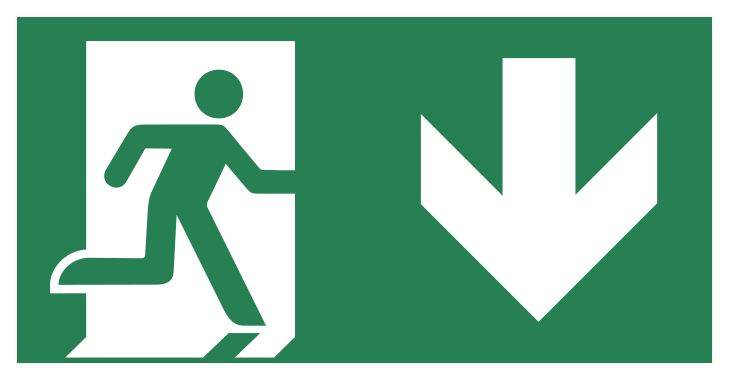
Down
- Proceed down — change of level (not “straight on”).
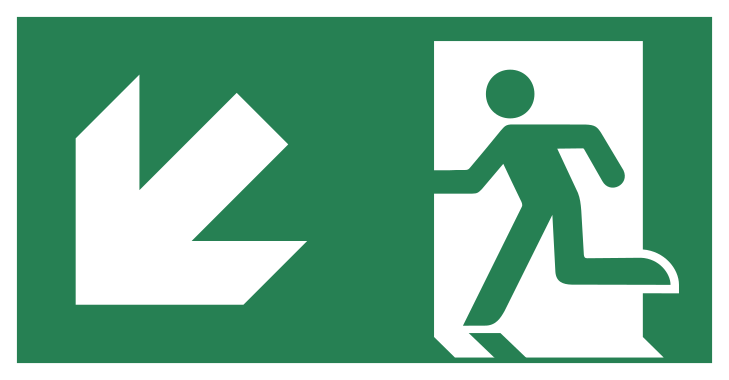
Down to the left
- Proceed down to the left — change of level.
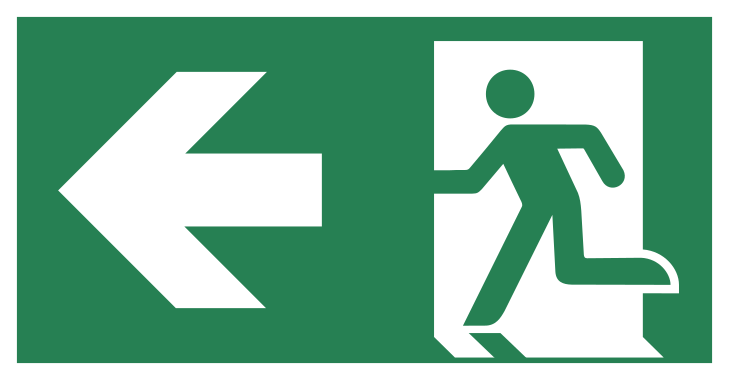
To the left
- Proceed to the left from here.
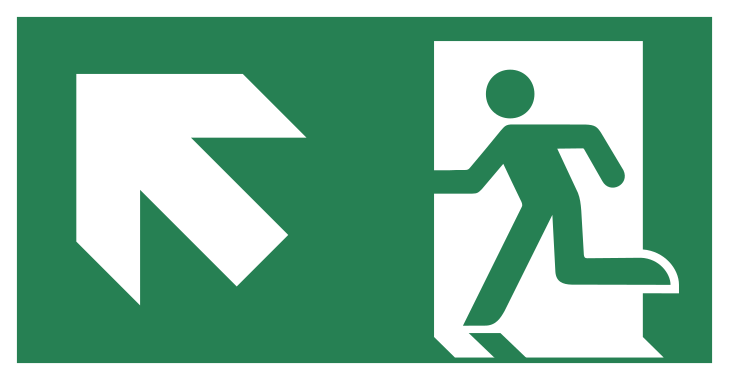
Up to the left
- Proceed up to the left — change of level.
- Proceed forward and across to the left — when in an open area.
The most common mistake: the arrow down
In practice the arrow down is often used for “straight on” or “through the door” — above an exit door. That is wrong. Those directions are shown only with an arrow up.
The mistake comes from the assumption that the arrow must point at the door you exit through. But the arrow shows the route or the change of level. That is why the arrow down is given only the meaning “go down”.
✓ Correct
Above the door: up arrow — “go through the door”.
✗ Wrong
Down arrow above the door — it means “go down”, not “go through”.
The place of mounting is part of the meaning
The same sign means different things in different places. An arrow to the right at a corridor corner means “turn right here”, and above a door — “go through it”. Special attention is needed at:
- places where direction changes;
- intermediate doors along the route;
- staircases, when the route leads up or down.
What else to know
- The colour is standardised — a white pictogram on a green background. More in the article on fire safety symbols.
- Do not use signs with the word EXIT — that is American practice, not a European standard.
- The signs must form an unbroken chain to a safe place or assembly point.
- We use the same symbols and colours in evacuation schemes.
We design emergency lighting and route marking that fit the real layout of the facility. If you are not sure whether the signs in your building are correctly chosen and mounted, get in touch.